Service / 02 · MVP build
Production-grade
in weeks, not quarters.
An MVP is not a demo with a login screen. It is the smallest version of the product that can carry real users, real money and real data: which means the boring parts have to be right the first time. We bring the blocks every product needs so your team’s time goes into the part that is actually yours.
The assembly
An MVP that survives its own success.
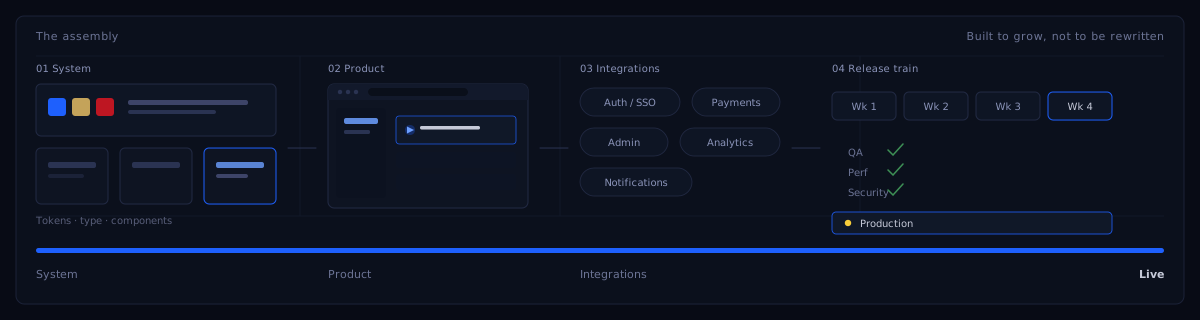
Design system, core flows, real integrations, weekly releases: built to grow, not to be rewritten.
The assembly System to production
The detail
What you actually get.
Phases
How the weeks are spent
- 01
- Design system: the type, colour, components and states everything else is assembled from.
- 02
- Core flows: the journeys that make the product worth opening, built as production code.
- 03
- Integrations: auth and SSO, payments, admin, analytics, notifications.
- 04
- Hardening: QA, performance, security and accessibility passes before anyone signs off.
- 05
- Launch: production release, monitoring, and the first iteration already scoped.
The standard blocks
What we bring, so you don’t rebuild it
- Authentication and enterprise SSO, including directory-backed sign-on for government and corporate customers.
- Payments and the local rails that actually matter in the Gulf, alongside the global processors.
- Admin and operations dashboards: the surface every team discovers it needs in month two.
- Analytics foundations, notifications, and the reporting your first board meeting will ask for.
Team shape
The proof
Where this has already run.
Client-scale figures are the clients’ own public figures, shown as client context: never as Rubikal outcomes.
A WordPress course site rebuilt into two production platforms on Rails and React, 2020–2024.
Four surfaces: patient app, doctor web, admin and marketing site: delivered under GDPR.
A React and Rails platform with three personas, then a native build carried through 2022–2025.
Before you ask
The questions that decide it.
How is this different from the prototype sprint?
The sprint answers “is this worth building?” in a week. The MVP build answers “can real people use this every day?”: production code, real integrations, QA, and a release cadence. Many clients run the sprint first and start the build from its output.
Can you work from a spec or designs we already have?
Yes, and it usually shortens the front end of the build. We will still pressure-test the scope before we start: an agreed definition of the first release is the single biggest predictor of whether the date holds.
What happens after launch?
Either we keep iterating with the same team on a rolling cadence, or we hand over and your engineers take it: repo, infrastructure, runbooks and all. Both are normal endings; neither costs you the code.
An MVP that survives its own success.
Three questions and twenty seconds gets you a recommended engagement, an indicative team and a timeline. No email required.