Service / 05 · AI engineering
AI that ships:
RAG systems, agents, and evaluated delivery.
The demo is the easy part. What decides whether an AI feature survives is everything around the model: which systems it can actually see, how the retrieval is grounded, how you measure whether an answer was right, and who is accountable when it is not. That is the work we do.
The pipeline
AI features grounded in your data, with the evaluation to prove it.
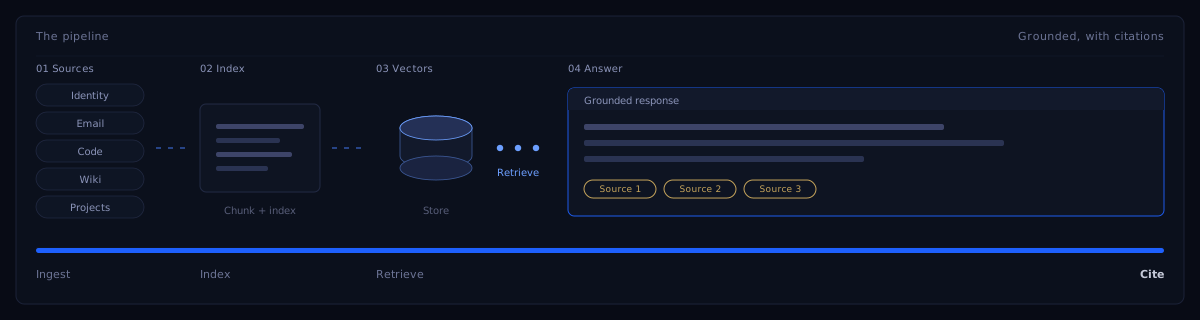
Integrations, retrieval, evaluation and guardrails: the parts that decide whether an AI feature survives contact with users.
The pipeline Grounded retrieval
The detail
What you actually get.
Sources
Where the grounding comes from
- Email, identity and calendars: the systems that already know who did what, and when.
- Project management, source control and wikis: where the actual work is recorded.
- Messaging and HR tooling: the context that never makes it into a document.
- Your own product data, which is usually the source that makes the answer worth reading.
The loop
Build, measure, guard
- Build
- Ingestion, chunking, indexing and retrieval: the plumbing that decides answer quality.
- Measure
- An evaluation set and a score you can regress against, not a vibe check in a demo.
- Guard
- Citations, refusal behaviour, and compliance tooling wired in during development.
- Ship
- Senior review on every architecture decision, and a human accountable for the output.
Team shape
The proof
Where this has already run.
Client-scale figures are the clients’ own public figures, shown as client context: never as Rubikal outcomes.
We designed and built an AWS-native AI platform MVP: eight integration families feeding a Vectara-backed RAG pipeline, with model evaluation and compliance tooling.
An embedded full-stack cell on an IDE for building, testing and debugging AI models: React, .NET Core and AWS.
AI runs through our own research, design, code and QA. It is why a prototype lands in five days and why we price the way we do.
Before you ask
The questions that decide it.
Is this a wrapper around someone else’s model?
The model is the smallest part. The work is the integration surface, the retrieval quality, the evaluation harness and the guardrails: which is exactly what an AWS-native platform MVP with eight integration families and a Vectara-backed pipeline consisted of.
How do you know the answers are any good?
Because we measure them. An evaluation set and a score you can regress against goes in during the build, not after the complaints. Citations are part of the interface so a reader can check the grounding themselves.
Does AI replace your engineers?
No, and the distinction matters commercially. AI removes the slow parts of research, design, code and QA. Senior engineers own every architecture decision and every line that ships: speed is the tool, judgment is the product.
AI features grounded in your data, with the evaluation to prove it.
Three questions and twenty seconds gets you a recommended engagement, an indicative team and a timeline. No email required.